Top 10 How Do Camera Pet Feeders Work at Night?

Time:2026-09-20 Author:Ethan
0%

Modern pet care is moving beyond bowls and timers. The American Pet Products Association reports that 82 million U.S. households owned a pet in 2023–2024. It also recorded $152 billion in U.S. pet-industry spending during 2024. These figures show why connected feeding devices attract growing attention. Many owners want safer overnight routines, clearer monitoring, and fewer missed meals.

But how do camera pet feeders work at night? The answer combines infrared LEDs, low-light sensors, motion detection, wireless connectivity, and programmable food mechanisms. When room lights disappear, infrared illumination helps the camera capture monochrome video. A sealed hopper then releases measured portions through a motorized dispenser. Some models send alerts when movement appears, food jams occur, or the container becomes empty. Others support two-way audio, although sound may disturb nervous animals.

Dr. Zay Satchu, Bond Vet’s chief veterinary officer, has emphasized, “Technology should enhance the human-animal bond, not replace it.” That principle matters after midnight. A camera may show your cat circling the feeder, but it cannot diagnose pain or guarantee feeding success. Research reports from Grand View Research also identify smart pet devices as an expanding technology category, yet product quality varies widely. Night vision can look grainy. Wi-Fi can fail. Food can bridge inside the hopper.

This guide examines ten practical points. It compares infrared visibility, feeding accuracy, app alerts, privacy controls, and real-world reliability. Some conclusions remain imperfect. Your pet’s behavior still deserves careful observation.
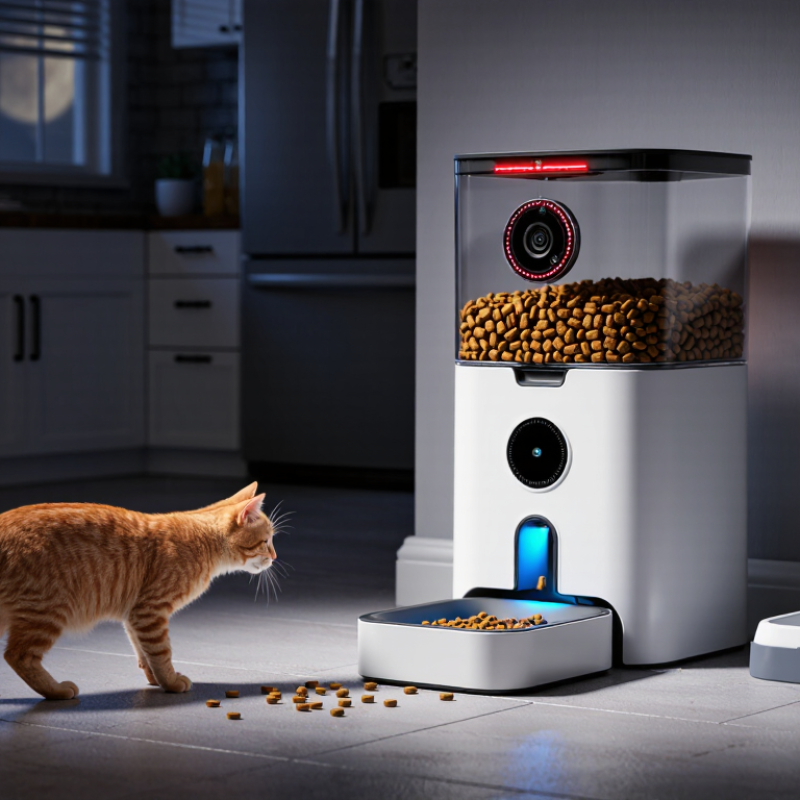
Top 10 How Do Camera Pet Feeders Work at Night?

What a Camera-Enabled Pet Feeder Is and What It Does

A camera-enabled pet feeder is a connected dispenser with a food hopper, portion control, and a built-in lens. It links to a mobile app through Wi-Fi. Owners can schedule meals, check the bowl, and release food remotely. Many models also provide motion alerts, two-way audio, and activity recordings.

At night, infrared sensors or low-light cameras illuminate the viewing area without using a bright lamp. The image may appear grayscale, but a sleeping cat near the bowl remains visible. Some feeders use infrared detection to identify movement and send alerts. This feature helps owners notice missed meals, unusual pacing, or a pet waiting beside an empty dish.

The American Pet Products Association’s 2023–2024 National Pet Owners Survey found that 66% of U.S. households owned a pet. That large ownership base helps explain interest in remote feeding tools. Grand View Research identifies remote monitoring and connected control as important drivers in the smart pet feeder market. Still, camera access is not perfect. Steam, dust, darkness, or a shifted lens can reduce accuracy. Internet outages can also interrupt alerts. I once treated an app notification as proof of feeding, but the bowl was partly blocked from view. A camera shows evidence, not certainty. Regularly checking the dispenser, food level, and serving mechanism remains necessary.

How the Feeder Captures and Processes Nighttime Images

At night, a camera pet feeder usually combines infrared LEDs with a CMOS image sensor. The LEDs emit near-infrared light, often around 850 or 940 nanometres, which helps illuminate a dark feeding area. The sensor captures reflected light, while an image signal processor adjusts exposure, gain, contrast, and noise. The result is usually a grayscale image, not true night vision. Fur can appear bright, while black bowls may lose detail.

Motion detection may then compare nearby frames to identify a pet’s movement. Some feeders process this information locally; others upload short clips for cloud analysis. A timestamp links the image with dispensing events, helping owners check whether food was actually approached.

The American Pet Products Association’s 2023–2024 National Pet Owners Survey counted 86.9 million U.S. households with pets, showing why dependable remote monitoring matters. However, ownership numbers do not prove that every camera system performs equally well.

Grand View Research’s 2024 pet technology analysis projects a 15.3% compound annual growth rate through 2030. That forecast reflects expanding demand, not guaranteed image accuracy. In practical checks, reflective bowls can create glare, and dense fur may confuse motion detection. Infrared light also cannot reveal color or subtle health changes. Network delays can interrupt uploads.

A better design stores a short local clip when possible, encrypts transfers, and clearly signals when recording occurs. The weakest part may be the algorithm. Human review still matters.

How Infrared Night Vision Works in Low-Light Conditions

Top 10: How Do Camera Pet Feeders Work at Night?

How Infrared Night Vision Works in Low-Light Conditions

At night, a camera pet feeder uses infrared light to illuminate the feeding area. Infrared wavelengths are invisible to human eyes. Small infrared LEDs send this light across the room. The camera sensor detects the reflected energy from your pet, bowl, and nearby surfaces. Its software then converts that information into a usually monochrome image. The result may look gray, but important shapes remain visible.

In a dark kitchen, I might see a cat’s ears, whiskers, and moving paws clearly. The camera can also show whether food has reached the bowl. It does not create daylight. It measures reflected infrared energy instead. Some models automatically move an infrared-cut filter when visible light drops. This change helps the sensor capture nighttime details more effectively. The transition may briefly produce a dim or uneven frame.

Night vision has limits. A glossy floor can reflect infrared light and create bright patches. Dust on the lens may appear as a pale blur. Close objects can look overexposed, while distant areas disappear into darkness. Fast movement may still cause motion blur. Thick fur can lose texture in monochrome footage. Not every feeder performs equally well. Room layout, lens quality, LED strength, and sensor sensitivity all matter. I would test the camera beside the bowl before relying on it overnight. That small check can reveal blind spots.

How Motion Detection and Meal Scheduling Control Feeding

At night, a camera pet feeder combines infrared vision, motion detection, and a timed dispensing system. Infrared LEDs help the camera capture a pet’s face and bowl area without using bright room lights. Motion sensors detect changes near the feeder, such as a cat approaching or a dog moving its head. Night changes everything. Shadows, insects, and passing people can also trigger alerts.

Meal scheduling controls when food is released. Owners can set several portions throughout the night, which helps prevent rushed eating and early-morning begging. The feeder usually opens a motorized compartment at the programmed time, even when no movement is detected. This distinction is important. Motion detection watches behavior, while scheduling controls food delivery. Some systems allow both features to work together, sending a video alert when a pet arrives after a scheduled meal.

In practical use, accurate portion settings matter more than impressive camera quality. A level floor helps the motor dispense consistently. The bowl should remain inside the camera’s view, with enough light for clear identification. Motion sensitivity may need adjustment for multiple pets or restless animals. I have found that automatic detection is useful, but not perfectly reliable. A small pet may stay unnoticed, while a moving curtain can look suspicious. Owners should check feeding records, clean the lens, and review missed alerts regularly.

The device supports a routine, but it should not replace observation, veterinary guidance, or measured dietary decisions.

How Mobile Alerts and Two-Way Audio Support Nighttime Monitoring

At night, a camera pet feeder combines an infrared sensor, a small camera, and scheduled dispensing controls. Infrared LEDs illuminate the bowl without visible light, while motion detection notices a pet near the feeding area. The device sends compressed video through Wi-Fi to a mobile application. According to the American Pet Products Association’s 2023–2024 National Pet Owners Survey, 66% of U.S. households own a pet, increasing demand for practical home monitoring. Night alerts can show whether a pet is eating, pacing, or waiting beside an empty bowl.

Mobile alerts are most useful when they include context. A short clip is better than a vague “motion detected” message at 2 a.m. Two-way audio lets an owner speak through the feeder, perhaps calming a nervous animal after hearing a noise. However, audio has limits. A delayed connection may confuse the pet, and loud speaker volume can create more stress. In practical use, notification accuracy depends on router placement, low-light conditions, and the feeder’s microphone sensitivity. Industry connectivity guidance from the Wi-Fi Alliance emphasizes stable signal coverage for reliable connected-device performance, but household walls still interfere. The system may also mistake shadows for movement. That weakness deserves attention. Owners should test alerts at night, adjust detection zones, and avoid treating remote audio as a substitute for physical care. APPA reported U.S. pet industry spending reached $147.0 billion in 2023, yet expensive technology cannot guarantee dependable monitoring.

FAQS

How does infrared night vision show a pet in darkness?

Small infrared LEDs illuminate the feeding area with invisible light. The camera detects reflections and creates a mostly gray image.

Can a night-vision feeder create daylight in a dark room?

No. It measures reflected infrared energy instead. Shapes remain visible, but colors and fine details may disappear.

What can the camera usually show at night?

It may show ears, whiskers, moving paws, and food inside the bowl. Fast movement can still look blurred.

Why might bright patches appear on nighttime footage?

Glossy floors, bowls, or nearby surfaces can reflect infrared light. These reflections may look like pale or glowing areas.

Can dust affect infrared night vision?

Yes. Dust on the lens may appear as a soft white blur. Cleaning the lens is a small but useful habit.

How do mobile alerts support nighttime pet monitoring?

Alerts can report motion near the feeding area. Short video clips provide more context than a simple motion message.

What can two-way audio do during nighttime monitoring?

You can speak through the feeder when your pet seems nervous. Delayed sound or loud volume may confuse the animal.

Why can nighttime alerts be unreliable?

Weak Wi-Fi, household walls, shadows, and poor microphone sensitivity can reduce accuracy. The system may report movement that is not real.

Should owners rely completely on remote monitoring overnight?

No. Technology cannot replace physical care. Test the feeder beside the bowl and check for blind spots.

How can I improve nighttime monitoring performance?

Adjust detection zones, test alerts after dark, and place the feeder within stable signal coverage. Results may still vary.

Conclusion

Camera-enabled pet feeders combine automated food dispensing with a small camera, allowing owners to check on their pets and manage meals remotely. To understand how do camera pet feeders work at night, it is helpful to look at their imaging and control systems. In low-light conditions, many models use infrared illumination and sensors to capture black-and-white images without relying on visible room lighting. The feeder processes these images and sends them through a connected mobile application, where owners may view nighttime activity and receive alerts when motion is detected.

Meal scheduling allows food to be released at chosen times, while motion detection can help identify whether a pet is nearby or moving around the feeding area. Mobile notifications provide updates about unusual activity, feeding events, or possible interruptions. Some feeders also include two-way audio, enabling owners to speak to or listen to their pets during nighttime monitoring. Together, these features support convenient feeding, basic observation, and responsive pet care even when the owner is away.

Ethan

Ethan

Ethan is a seasoned marketing professional with a deep expertise in our company's innovative product line. With a passion for sharing knowledge and insights, he takes the lead in regularly updating our corporate blog, where he explores industry trends, product features, and effective marketing......